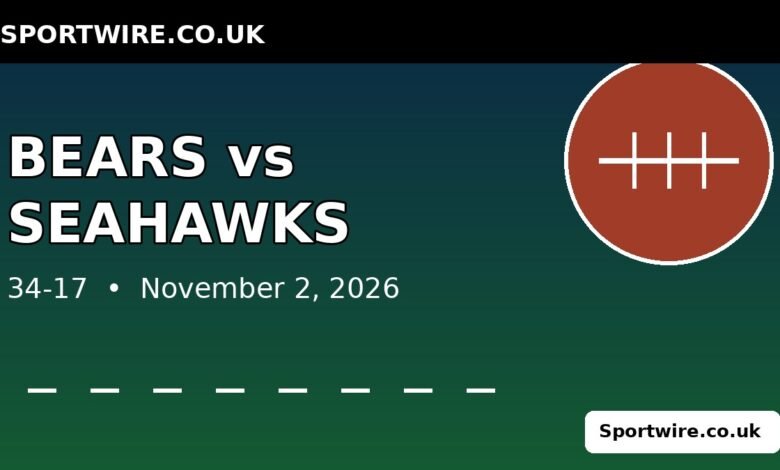
The Chicago Bears beat the Seattle Seahawks 34-17 on Monday Night Football on November 2, 2026, at Lumen Field in Seattle. Chicago never trailed in the Week 8 game, led 13-9 at half-time, pulled away in the fourth quarter, and improved to 6-2, while Seattle fell to 4-4. If you are looking for the short answer to Bears vs Seahawks November 2 2026, that is it: a controlled, physical road win for Chicago, sealed by three second-half rushing touchdowns from D’Andre Swift. For another recent result on a different topic, see Yankees vs Blue Jays October 23, 2026: New York Wins 8-2 at Home.
The final margin does not quite tell the whole story, because Seattle did make this a game again in the fourth quarter. With 11:46 left, the Seahawks cut a 20-9 deficit to 20-17, and for a brief moment Lumen Field had the noise and momentum that have made it one of the hardest road venues in the NFL. Chicago answered the way good road teams have to answer: with a scoring drive, then a defensive takeaway, then another scoring drive. By the time Swift crossed the goal line for the third time, with 4:41 remaining, there was no realistic way back for the home side.
That response is what will matter most when this game is remembered. Anyone can build a lead on a Monday night. Holding it, and then rebuilding it after the other team has fought back, is a different test, and Chicago passed it. The Bears vs Seahawks November 2 2026 game therefore works as a useful measuring stick for both teams: Chicago looked like a team that knows how it wants to win, while Seattle looked like a team still searching for a reliable second way to move the ball when its first plan is taken away.
How the Bears vs Seahawks November 2 2026 Game Unfolded
Chicago set the tone from the very first possession. The Bears put together a 17-play, 80-yard touchdown drive that took 8:32 off the clock, ending with Caleb Williams rolling to his right and finding Luther Burden III for a one-yard touchdown. It was a statement drive in every sense: long, patient, and finished in the end zone rather than with a field goal. It also broke a notable Seattle streak, ending 16 straight games in which the Seahawks had not allowed their opponent to score on the opening possession. When a visiting team does that on the road in prime time, it changes the feel of the whole evening.
Seattle did not fold after that opening drive. The Seahawks got on the scoreboard in the second quarter when Jason Myers kicked a 27-yard field goal, cutting the lead to 7-3. Chicago answered with field goals of its own, as Cairo Santos converted from 44 yards and then from 38 yards to push the lead to 13-3. Just when it looked as though the Bears would take a comfortable ten-point lead into half-time, Seattle struck back. With only 30 seconds left in the half, Sam Darnold found Jaxon Smith-Njigba down the left sideline for a 43-yard touchdown on third-and-10. Myers missed the extra point, so the half-time score stayed at 13-9, but Seattle had at least given itself something to build on.
The third quarter belonged to Chicago’s ground game and its patience. Swift scored on a one-yard run with 5:38 left in the third quarter, stretching the lead to 20-9. That touchdown capped another methodical Chicago drive and rewarded an offensive line that kept finding just enough room near the goal line, even when Seattle knew what was coming. Swift’s yardage total for the night was modest, but his timing was perfect: all three of his touchdowns came after half-time, when the game was there to be won.
Early in the fourth quarter, Seattle had a chance to get back within one score, but Austin Booker blocked Myers’ 33-yard field-goal attempt with 14:09 remaining, preserving the 20-9 lead. That block looked, for a short while, like the play that would end Seattle’s hopes. Instead, the game swung again almost immediately. DeMarcus Lawrence forced and recovered a fumble by Chicago tight end Colston Loveland at the Chicago 25-yard line, giving Seattle a short field. Three plays later, Darnold rolled left and found Cooper Kupp for a seven-yard touchdown, and Darnold’s two-point pass to Tory Horton made it 20-17 with 11:46 to play.
What happened next decided the Bears vs Seahawks November 2 2026 result. Chicago did not panic, did not abandon its plan, and did not give the ball away. The Bears drove for a touchdown, with Swift scoring from five yards with 8:28 remaining to restore a ten-point lead at 27-17. A key moment on that drive was a 39-yard run by Kalif Raymond, which gave Chicago field position and momentum when it needed both. Then the defence finished the job: Austin Booker tipped a Darnold pass, defensive lineman James Lynch intercepted it and returned it to the Seattle six-yard line, and Swift scored again from five yards with 4:41 left to make the final score 34-17.
Caleb Williams Controlled the Game Without Forcing It
Caleb Williams finished 24-of-34 passing for 247 yards, with one touchdown and no interceptions, for a passer rating of 101.0. Those numbers are impressive on their own, but they are even more impressive in context. Seattle’s defence had not allowed a quarterback to pass for more than 200 yards in a game all season before this one, and Williams passed that mark comfortably while taking only one sack and committing no turnovers. He completed just over 70 percent of his passes, and his one touchdown pass came on the opening drive, when the game was still scoreless and the pressure was at its highest.
Williams’ best work was not a single highlight throw. It was the accumulation of good decisions: taking what Seattle gave him, moving the chains, letting the running game and the offensive line do their jobs, and keeping Chicago ahead of the chains often enough that third down rarely became desperate. He ran only twice for one yard, which tells its own story. This was not a night when Chicago needed its quarterback to escape trouble again and again. It was a night when the quarterback kept the offence on schedule, and the rest of the team did the heavy lifting around him.
That balance matters for Chicago’s season. A quarterback who can win a prime-time road game without needing a huge yardage total, and without turning the ball over against a strong defence, gives his coaches far more options. Chicago could lean on Swift near the goal line, could kick field goals early without chasing points, and could trust its defence late because it was not playing from behind. Williams did not have to be spectacular in the Bears vs Seahawks November 2 2026 game. He had to be steady, accurate, and calm, and he was all three.
Sam Darnold, by contrast, had a much harder night. He finished 17-of-34 for 188 yards, with two touchdowns and one interception, and he was sacked three times. His two touchdown passes showed his quality: the 43-yard strike to Smith-Njigba just before half-time was a superb throw under pressure, and the seven-yard touchdown to Kupp in the fourth quarter briefly brought Seattle back into the game. But Darnold also spent much of the night under pressure, Seattle converted only 1 of 11 third downs, and the late interception by Lynch came at exactly the wrong moment, turning a three-point deficit into a ten-point deficit and then, after Swift’s final score, a seventeen-point one.
D’Andre Swift and Jeffery Simmons Made the Difference
D’Andre Swift’s stat line will not win any fantasy football awards on yardage alone: 27 carries for 69 yards, an average of 2.6 yards per carry. Yet nobody who watched the game would doubt that he was one of its most important players. He scored three rushing touchdowns, all in the second half, from one yard, five yards, and five yards. That is the profile of a back trusted in the red zone, and Chicago was a perfect 4-for-4 in the red zone on the night. Seattle, by contrast, scored a touchdown on only one of its four red-zone trips. In a game decided by red-zone efficiency, that gap was worth more than any single long run.
Swift’s second three-touchdown game of the season also showed Chicago’s patience. A back averaging under three yards per carry can easily become a reason to abandon the run. Chicago did the opposite. The Bears kept giving Swift the ball near the goal line, kept trusting their offensive line in short yardage, and were rewarded three times. The 39-yard run by Raymond on the go-ahead fourth-quarter drive was the explosive play, but Swift’s short-yardage finishes were the points, and points are what decide games.
On the other side of the ball, Jeffery Simmons made an immediate impact in his first game as a Bear. Simmons recorded a sack and two tackles for loss, finishing with six tackles in total. Reports from the night noted that his sack came early in his Bears debut, and his presence in the middle of the defensive line helped Chicago hold Seattle to 81 rushing yards and 252 total yards. Seattle’s backs never found consistent room: Jadarian Price led the Seahawks with 29 yards on 10 carries, and Zach Charbonnet added 23 yards on six carries. When a defence takes away the run and forces an offence into obvious passing downs, sacks and turnovers usually follow, and that is what happened late in this game.
Simmons was not alone. Montez Sweat and Devin Bush each recorded a sack for Chicago, Booker blocked a field goal and tipped the pass that became Lynch’s interception, and Lynch’s return set up the clinching touchdown. This was a team defensive performance rather than a one-man show, but Simmons’ debut gave it a clear focal point. For a Bears team trying to prove it belongs among the contenders, adding a disruptive interior defender and then watching him deliver on his first night is exactly the kind of addition that changes how opponents prepare.
Full Box Score: Bears vs Seahawks November 2 2026
The table below gives the quarter-by-quarter score for the Bears vs Seahawks November 2 2026 game, followed by the leading player statistics for both teams. All figures below were cross-checked against multiple covering sources, including the Covers matchup page, the Statz NFL box score, and Reuters / Field Level Media reporting.
| Team | Q1 | Q2 | Q3 | Q4 | Total |
|---|---|---|---|---|---|
| Chicago Bears | 7 | 6 | 7 | 14 | 34 |
| Seattle Seahawks | 0 | 9 | 0 | 8 | 17 |
Scoring summary: Q1 – Luther Burden III, 1-yard pass from Caleb Williams (Cairo Santos kick), 7-0 Chicago. Q2 – Jason Myers, 27-yard field goal, 7-3; Santos, 44-yard field goal, 10-3; Santos, 38-yard field goal, 13-3; Jaxon Smith-Njigba, 43-yard pass from Sam Darnold (kick failed), 13-9. Q3 – D’Andre Swift, 1-yard run (Santos kick), 20-9. Q4 – Cooper Kupp, 7-yard pass from Darnold, plus Tory Horton two-point conversion pass from Darnold, 20-17; Swift, 5-yard run (Santos kick), 27-17; Swift, 5-yard run (Santos kick), 34-17.
| Passing | Comp-Att | Yards | TD | INT |
|---|---|---|---|---|
| Caleb Williams (Chicago) | 24-34 | 247 | 1 | 0 |
| Sam Darnold (Seattle) | 17-34 | 188 | 2 | 1 |
| Rushing | Carries | Yards | TD |
|---|---|---|---|
| D’Andre Swift (Chicago) | 27 | 69 | 3 |
| Kalif Raymond (Chicago) | 1 | 39 | 0 |
| Roschon Johnson (Chicago) | 5 | 17 | 0 |
| Caleb Williams (Chicago) | 2 | 1 | 0 |
| Jadarian Price (Seattle) | 10 | 29 | 0 |
| Zach Charbonnet (Seattle) | 6 | 23 | 0 |
| Sam Darnold (Seattle) | 2 | 20 | 0 |
| George Holani (Seattle) | 1 | 9 | 0 |
| Receiving | Catches | Yards | TD |
|---|---|---|---|
| Rome Odunze (Chicago) | 4 | 87 | 0 |
| Colston Loveland (Chicago) | 7 | 65 | 0 |
| Luther Burden III (Chicago) | 7 | 56 | 1 |
| Kalif Raymond (Chicago) | 2 | 14 | 0 |
| Roschon Johnson (Chicago) | 1 | 11 | 0 |
| D’Andre Swift (Chicago) | 2 | 10 | 0 |
| Zavion Thomas (Chicago) | 1 | 4 | 0 |
| Jaxon Smith-Njigba (Seattle) | 6 | 118 | 1 |
| Tory Horton (Seattle) | 3 | 26 | 0 |
| AJ Barner (Seattle) | 2 | 23 | 0 |
| Jadarian Price (Seattle) | 2 | 8 | 0 |
| Cooper Kupp (Seattle) | 1 | 7 | 1 |
| Zach Charbonnet (Seattle) | 3 | 6 | 0 |
Team totals and defence: Chicago outgained Seattle 363 yards to 252, held the ball for 35:03 compared with Seattle’s 24:57, and finished with 22 first downs to Seattle’s 18. Chicago rushed 35 times for 126 yards; Seattle rushed 19 times for 81 yards. Cairo Santos made both of his field goals and all four extra points for Chicago, while Jason Myers made one of two field goals for Seattle. On defence, Jeffery Simmons had a sack and two tackles for loss in his Chicago debut, James Lynch intercepted Darnold late in the fourth quarter, and Seattle’s only sack came from Mike Morris.
Analysis: What This Win Says About Chicago, and What It Exposes About Seattle
The first lesson from this game is that Chicago can win in more than one way. Earlier in the season, the Bears’ story was often told through their quarterback and their explosive plays. Against Seattle, the story was control: a 17-play opening drive, a 35-minute time of possession, a perfect red-zone record, and a defence that made Seattle earn every yard. Teams that can only win shootouts eventually meet a defence that stops the shootout. Chicago showed on Monday night that it has a second identity to fall back on, and that second identity travels well, even into one of the loudest stadiums in the league.
The second lesson concerns Seattle’s offence, and it is less comfortable. Jaxon Smith-Njigba was outstanding again, with six catches for 118 yards and a touchdown, and he has now put together another 100-yard game in a season full of them. But beyond Smith-Njigba, Seattle’s passing game produced very little: the next-highest receiver total was Tory Horton’s 26 yards, and Cooper Kupp’s only catch was his fourth-quarter touchdown. When one receiver accounts for 118 of a team’s 188 passing yards, the offence becomes predictable, and predictable offences struggle on third down. Seattle’s 1-of-11 third-down record is the clearest single number in the box score, because it explains why the Seahawks had so few sustained drives and why their defence spent so much time on the field.
The third lesson is about momentum, and how quickly it can change in the NFL. Seattle did everything right for about five minutes in the fourth quarter: a forced fumble, a short field, a touchdown, and a two-point conversion. At 20-17, the game was genuinely alive. Chicago’s answer, however, was the most mature sequence of its season so far. There was no panic, no forced deep throw, and no defensive collapse. There was a scoring drive, a tipped pass, an interception, and a clinching touchdown. If Chicago can repeat that composure in closer games later in the season, this win will look less like an upset of the defending champions and more like an early sign of a team arriving ahead of schedule. For Seattle, the task is clearer but no easier: find a second reliable receiver, fix third down, and protect a quarterback who cannot keep taking three sacks and playing from behind against good defences.
For readers following the Bears vs Seahawks November 2 2026 game for fantasy or betting context, the takeaways are equally straightforward. Swift’s value in this offence is tied to touchdowns rather than yardage, Williams’ value is tied to efficiency and ball security rather than volume, and Smith-Njigba remains Seattle’s one must-start receiving option regardless of matchup. Chicago’s defence, with Simmons added to the middle, is also becoming a harder unit to run against, which will matter for every opposing backfield it faces from here on.
Chicago now moves to 6-2, and Seattle drops to 4-4. Both records tell a fair story after eight weeks: Chicago has won three games in a row and beaten the champions of both conferences in prime time, while Seattle has lost ground in a crowded NFC race and must now regroup at home. The Bears vs Seahawks November 2 2026 result will not decide either team’s season on its own, but it has changed how both teams should be judged. Chicago is no longer a surprise package. Seattle is no longer able to rely on reputation alone.
Frequently Asked Questions
Who won Bears vs Seahawks November 2 2026?
The Chicago Bears won. They beat the Seattle Seahawks 34-17 at Lumen Field in Seattle on Monday Night Football on November 2, 2026, improving to 6-2 while Seattle fell to 4-4.
What was the final score of Bears vs Seahawks November 2 2026?
The final score was Chicago Bears 34, Seattle Seahawks 17. Chicago led 7-0 after the first quarter, 13-9 at half-time, and 20-9 after the third quarter, before scoring 14 points in the fourth quarter to Seattle’s eight.
How many touchdowns did D’Andre Swift score against Seattle?
D’Andre Swift scored three rushing touchdowns, all in the second half. He scored from one yard in the third quarter and from five yards twice in the fourth quarter, finishing with 27 carries for 69 yards.
What were Caleb Williams’ stats against the Seahawks?
Caleb Williams completed 24 of 34 passes for 247 yards, with one touchdown and no interceptions, for a passer rating of 101.0. His touchdown pass was a one-yard throw to Luther Burden III on Chicago’s opening drive.
How did Jeffery Simmons play in his Bears debut?
Jeffery Simmons made an immediate impact in his first game for Chicago, recording a sack and two tackles for loss among six tackles in total. His debut helped Chicago hold Seattle to 252 total yards and only 81 rushing yards.
For further verified reporting on this game, see the Reuters match report: Reuters: D’Andre Swift scores 3 touchdowns as Bears down Seahawks. Chicago’s next test will be whether it can carry this road composure into its next game, while Seattle’s task is to fix third down and find more help for Jaxon Smith-Njigba before its home crowd expects a response.