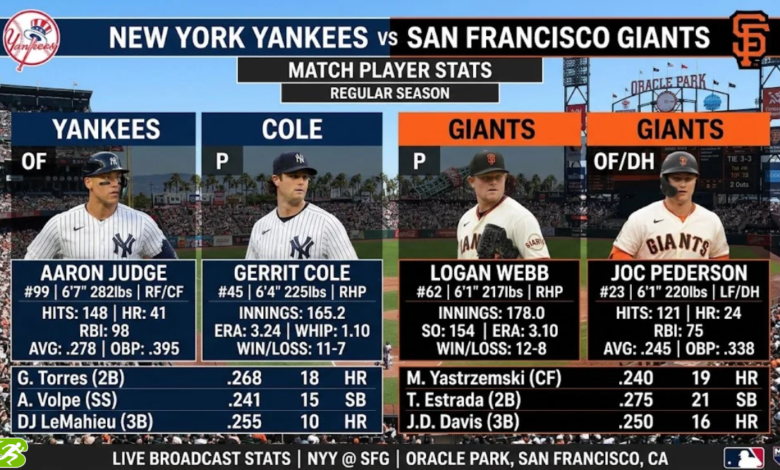
The New York Yankees defeated the San Francisco Giants 7-0 on March 25, 2026, at Oracle Park in San Francisco. The Yankees collected 10 hits, while the Giants managed three. Max Fried led New York with 6⅓ scoreless innings, and the Yankees built their lead with five runs in the second inning.
Yankees vs Giants Box Score: Final Score and Team Stats
The opening-day matchup gave the Yankees a strong start to their 2026 season. Their five-run second inning put immediate pressure on San Francisco, and two more runs in the fifth inning extended the advantage.
Here is the official team comparison for the March 25 game.
| Statistic | New York Yankees | San Francisco Giants |
| Final score | 7 | 0 |
| Hits | 10 | 3 |
| Errors | 1 | 1 |
| Home runs | 0 | 0 |
| Total bases | 12 | 3 |
| Stolen bases | 1 | 0 |
| Left on base | 6 | 7 |
The Yankees created more scoring opportunities and converted several of them into runs. Neither team hit a home run, so New York’s offense relied on timely singles, a double, a triple, and a defensive mistake by San Francisco.
The Giants had seven runners left on base, meaning those players did not score before their opportunities ended. Their three hits were not enough to overcome the early deficit.
For readers checking the Yankees vs Giants box score full player stats, the official MLB Gameday report provides the game record and play-by-play details.
New York Yankees Player Stats and Top Performers
New York’s offense produced runs through several different players rather than relying on a single home run. The second inning was especially productive, with José Caballero, Ryan McMahon, and Trent Grisham contributing to the five-run burst.
Trent Grisham
Grisham delivered one of the biggest offensive plays of the game with a two-run triple in the second inning. A triple is a hit that allows a batter to reach third base safely.
His hit helped push the Yankees’ lead to 5-0 before San Francisco could settle into the game. Grisham’s contribution was particularly valuable because one swing brought two runners home.
Ryan McMahon
McMahon recorded a two-run single during the second-inning rally. A single allows the batter to reach first base safely on a hit.
He also drew a walk and scored a run, according to MLB’s game report. His performance helped New York turn early baserunners into a comfortable lead.
José Caballero
Caballero hit an RBI double in the second inning. An RBI, or run batted in, is credited when a batter’s action produces a run under official scoring rules.
Caballero’s double helped start the Yankees’ scoring surge. He also contributed on defense, making him one of the players involved in the game’s most important moments.
Austin Wells
Wells finished with two hits in three at-bats and scored a run. He also drew a walk, according to the official game summary.
His performance gave the Yankees another productive spot in the batting order. Reaching base through both hits and walks also helped New York maintain pressure on the Giants’ pitching staff.
Giancarlo Stanton and Ben Rice
Stanton drove in a run with a single in the fifth inning. That hit helped extend the Yankees’ lead to 6-0.
Rice later scored the seventh run on a forceout and throwing error. A forceout occurs when a defensive player gets a runner out at a base that the runner must reach because another runner is advancing. The error helped the Yankees add another run without recording a home run.
San Francisco Giants Player Stats and Offensive Results
San Francisco struggled to produce enough hits to challenge New York. The Giants finished with three hits, no runs, and one error.
That result does not mean every Giants hitter had a poor at-bat. Baseball outcomes depend on pitching, defense, and the timing of hits, so a team can make solid contact without producing runs.
The MLB game feed identifies several notable Giants offensive moments, including a single by Luis Arraez and hard-hit balls by other hitters. However, a hard-hit ball does not automatically become a hit or produce a run.
The following players were part of San Francisco’s starting lineup:
| Player | Position |
| Luis Arraez | Second base |
| Matt Chapman | Third base |
| Rafael Devers | Designated hitter |
| Willy Adames | Shortstop |
| Jung Hoo Lee | Right field |
| Heliot Ramos | Left field |
| Casey Schmitt | First base |
| Patrick Bailey | Catcher |
| Harrison Bader | Center field |
These are the starting positions listed by MLB for the game, not a claim that every player recorded the same number of at-bats or played every inning.
For complete individual batting totals, including at-bats, hits, runs, walks, and strikeouts, use the official MLB box score and play-by-play. Checking that record is preferable to filling gaps with unverified player statistics.
Pitching Stats: Max Fried vs. Logan Webb
Pitching was the biggest difference between the teams. Max Fried kept San Francisco off the scoreboard, while Logan Webb allowed the Yankees to build a substantial lead early in the game.
| Pitching statistic | Max Fried, Yankees | Logan Webb, Giants |
| Innings pitched | 6⅓ | 5 |
| Earned runs allowed | 0 | 6 |
| Strikeouts | 4 | 7 |
| Decision | Win | Loss |
Max Fried’s scoreless outing
Fried allowed two hits and no earned runs over 6⅓ innings. He struck out four batters and earned the win.
An earned run is a run charged to a pitcher under official scoring rules, excluding runs that would not have scored without certain defensive errors or passed balls. Fried’s scoreless performance gave the Yankees a dependable foundation for the rest of the game.
Logan Webb’s difficult start
Webb recorded seven strikeouts but allowed six earned runs in five innings. He took the loss.
Strikeouts are an important measure of a pitcher’s ability to retire hitters, but they don’t tell the entire story. Webb struck out more batters than Fried and still allowed more runs because the Yankees made their scoring opportunities count.
How to interpret ERA and WHIP
Two common pitching statistics help readers evaluate performance beyond wins and losses.
- ERA (earned run average): The average number of earned runs a pitcher allows per nine innings. Lower figures generally indicate better run prevention.
- WHIP (walks plus hits per inning pitched): The average number of walks and hits a pitcher allows per inning. Lower figures generally indicate better control of baserunners.
These statistics are most useful when comparing performances over multiple games. One outing provides a snapshot, not a complete measure of a pitcher’s ability. MLB provides detailed explanations in its official ERA glossary and WHIP glossary.
Yankees vs Giants Highlights: How the Game Unfolded
The scoring pattern explains why the Yankees controlled the matchup.
Second inning: New York takes control. Caballero’s RBI double, McMahon’s two-run single, and Grisham’s two-run triple helped the Yankees score five runs. It was the decisive stretch of the game.
Fifth inning: The lead grows. Stanton hit an RBI single, and Rice later scored on a forceout and throwing error. New York increased its advantage to 7-0.
Later innings: The Yankees preserve the shutout. Fried completed 6⅓ scoreless innings before the bullpen handled the remaining outs. San Francisco did not score, and New York finished with a seven-run victory.
A shutout occurs when one team prevents the other from scoring throughout the game. For fans reviewing highlights, the second inning is the best place to start because it contains the main scoring sequence.
Watch the official MLB game highlights for the scoring plays and defensive moments.
How to Read a Yankees vs Giants Box Score Correctly
A box score gives you a compact record of a baseball game. Knowing which figures to check first makes it easier to understand why one team won.
| Abbreviation | Meaning | What it tells you |
| AB | At-bats | How many official at-bats a hitter recorded |
| H | Hits | Successful hits |
| R | Runs | Times a player scored |
| RBI | Runs batted in | Runs credited to a batter |
| HR | Home runs | Hits that allow the batter to score without an intervening defensive play |
| BB | Walks | Times a batter receives first base after four balls |
| SO | Strikeouts | Batters retired by strike three, or hitters who strike out |
| IP | Innings pitched | How much work a pitcher completed |
| ER | Earned runs | Runs charged to the pitcher under scoring rules |
For batting, start with hits, runs, and RBIs. Then check walks and strikeouts to understand how a hitter reached base or ended an at-bat.
For pitching, compare innings, earned runs, and strikeouts. A pitcher who records several strikeouts can still struggle if too many hits and walks lead to runs.
MLB’s official batting average explanation is also useful. Batting average measures hits divided by at-bats, but it doesn’t account for walks or how valuable a hit was. That is why a single statistic should not determine your entire evaluation of a player.
Where to Find Verified Player Stats and Highlights
Use official records when you need figures for a baseball recap, fantasy baseball research, or a comparison between players.
- Full box score: MLB Gameday for the March 25, 2026 matchup.
- Video highlights: MLB Film Room for the game’s scoring plays and defensive highlights.
- Starting lineups: MLB’s March 25 lineup page for the announced starters.
These resources are best for readers who want documented results from a specific game. They’re less useful if you’re looking for a prediction of a future matchup, current player availability, or season-long comparisons. For those questions, check the relevant date and the latest official statistics instead.
One common mistake is to combine a player’s season average with their numbers from a single game. Those figures measure different things. Always label game-specific statistics separately from season totals, and check the date before publishing a score or player result.
Internal link ideas:
Frequently Asked Questions
1. Who won the Yankees vs Giants game on March 25, 2026?
The New York Yankees won 7-0. They scored five runs in the second inning and two in the fifth. Max Fried earned the pitching win, and the Giants were held scoreless. The official MLB game report is the best source for confirming the final result and individual statistics.
2. How many hits did the Yankees and Giants record?
The Yankees recorded 10 hits, while the Giants recorded three. Hits measure successful batting outcomes, but they don’t show the full value of every at-bat. To understand the difference between the teams, also compare runs, walks, extra-base hits, and errors in the official box score.
3. How many strikeouts did Max Fried and Logan Webb record?
Fried struck out four batters, and Webb struck out seven. Webb’s higher strikeout total didn’t prevent the Yankees from scoring six earned runs against him. When evaluating pitchers, look at both strikeouts and run prevention rather than treating either number as a complete measure of performance.
4. Did Aaron Judge hit a home run against the Giants?
No, the Yankees finished the game without a home run. Judge appeared in the starting lineup, but a player’s presence in the lineup doesn’t mean he recorded a hit or scored a run. Check the individual batting table in MLB Gameday to verify his exact at-bats and results for this game.
5. Where can I watch Yankees vs Giants highlights?
You can watch the available game highlights through MLB Film Room’s official video page. Look for Grisham’s two-run triple, McMahon’s two-run single, and Stanton’s RBI single. Video availability and playback access can vary by location, device, and MLB’s current streaming policies.
6. Are game player stats the same as season stats?
No, game stats describe one matchup, while season stats combine a player’s results across multiple games. A hitter who goes two-for-three in one game has a .667 batting average for that game, but that number doesn’t establish their season average. Always check the sample size and date before making comparisons.
7. When did the Yankees and Giants last play in this matchup?
The game covered here took place on March 25, 2026, at Oracle Park. If you need a different meeting between these teams, select the specific date in the official MLB schedule or game archive. Their player statistics and results can differ from one matchup to another.
Closing
Use the March 25, 2026 box score when you need the verified result of this specific game, and use the season statistics page when comparing players over time. Before publishing a player-by-player breakdown, confirm every batting and pitching line against the official game record.
You May Also Read
oklahoma city thunder vs san antonio spurs match player stats